Sidewalk Improvement Districts

Pedestrian safety is a high priority of the City of Rochester. With over 600 miles of sidewalk and 9,000 pedestrian ramps, the City performs annual maintenance projects on pedestrian facilities. This is to keep them accessible and safe for users and to efficiently extend the lives of these facilities through routine and preventative efforts.

On November 14, 2022, the City Council adopted the Sidewalk Improvement District program that reassigns the cost of sidewalk repairs and replacement from the adjacent property owner to a distribution among a greater portion of the community, as sidewalks are a benefit to and available for use by all.

Benefits of the Sidewalk Improvement District (SID) program include:

  1. A more understandable, predictable, convenient and affordable program for property owners.
  2. The cost of a walkable community is distributed among all residents.
  3. A more efficient program to administer.

What does this mean for property owners in Rochester?

  1. Responsibility for sidewalk repair will shift from the adjacent property owner to the City’s annual program. Property owners are asked to maintain the paint markings on the sidewalk until the City’s annual program addresses defects.
  2. The cost of repairing sidewalks will shift from the adjacent property owner to the Sidewalk Improvement Districts.
  3. Property owners will pay an annual Sidewalk Improvement District assessment; there will be no surprise sidewalk fees.
    • In 2020, under the previous sidewalk maintenance program, property owners paid an average of $854 for sidewalk repairs. It was common for properties to incur fees ranging from $3,000 to $5,000.
    • While the exact SID rate is determined by the project needs in one’s district, the average residential rate is estimated to be $57 annually.

When did this program go into effect?

With the City Council's adoption of the Sidewalk Improvement District program on November 14, 2022, the program's implementation included formal approval of the 2023 project area and associated assessment rates for District 1 in the winter of 2022/2023. Construction on the first project area occurred in Spring 2023.

Public Works inspects public pedestrian facilities to keep them accessible and safe for users and to extend their lives through routine and preventive maintenance.

The timeline for sidewalk construction projects is as follows:

  • Fall: Public Works inspectors identify and mark sidewalk defects in the upcoming project area.
  • Early Winter: Public Works develops proposed projects, requests project bids from contractors and determines the proposed rates.
  • Mid-Winter: City Council adopts an updated project area map, project budget and the 5-year assessment rate.
    • Property owners within the project District will receive a “Notice of Public Comment” that indicates the date Council will consider adoption of the annual SID project and welcoming them to speak during the public comment period.
  • Spring/Summer: Sidewalk construction only occurs in one Sidewalk Improvement District each year. Hazards outside the active district will be addressed on the SID schedule.

Upcoming District Schedule:

  • District 5 - SW: 2024 
  • District 1 - NW: 2025
  • District 2 - NC: 2026
  • District 3 - NE & Downtown: 2027
  • District 4 - SE: 2028

The SID billing process requires accurate mailing addresses for contributing parcels. To avoid tax issues with Olmsted County, parcel owners with address changes should submit a “Taxpayer Change of Mailing Address Request Form” to the County. Parcel owners seeking to combine multiple parcels should submit an “Olmsted Combination Request Application” to the County. Both forms can be found on Olmsted County's Recording & Abstracting Forms webpage.

Title 28, Section 35.133 of the Code of Federal Regulations requires public agencies to maintain walkways in an accessible condition in accordance with the Americans with Disabilities Act (ADA). The City of Rochester has a long tradition of delivering annual sidewalk reconstruction and maintenance projects to meet this commitment. The annual projects inspect, repair, and warrant approximately 5% of the city's defective sidewalks.

Historically, the annual sidewalk program was funded through a combination of tax levy and assessments on private parcels abutting the repairs. Under the authority provided in Minnesota Statute 435.44, the City Council will consider adopting a Sidewalk Improvement District (SID) Program in November 2022. The SID Program designates districts where the costs of repairing pedestrian facilities can be spread across all parcels based on real estate classification. The fees can be assessed over a period of up to five years.

The Sidewalk Improvement District concept has been discussed since October 2015. Follow the links below for videos of the most recent presentations to the City Council:

  • May 2, 2022, presentation
  • November 14, 2022, council meeting

Approximately 5% of the city’s sidewalks are inspected annually for defects as part of Rochester’s Americans with Disabilities Act (ADA) Transition Plan, adopted in 2013. In most cases, any given section of sidewalk outside of the downtown core is inspected once every 20 years. The downtown/Destination Medical Center (DMC) area is inspected every 5 years.

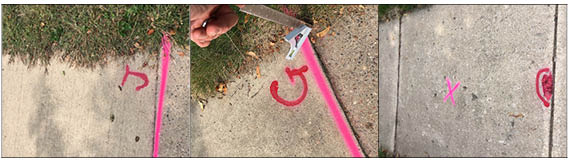
Sidewalks are inspected by Public Works Engineering Technicians for safety defects in response to complaints, reported falls or scheduled inspections of large areas of the city. Substandard sidewalk sections are marked with brightly colored pink paint to alert pedestrians to safety hazards.

Each year, Public Works compiles a list of defects noted in that year’s project area and the reported defects in the broader district. This list is used to develop an engineer’s estimate and feasibility report for the City Council to consider an authorization to bid the project.

Paint markings are used to identify safety hazards, including any raised hazard (tripper) over 1/4” and any hole/gap over 1/2". Sidewalk panels are also marked for eligible repair methods. Panels marked with a “J” stencil are eligible for mud jacking or other lifting methods. Panels marked with a “G” stencil are eligible for grinding or horizontal cutting. Panels marked with only an “X” must be replaced.

all sidewalk markings

The City of Rochester’s SID rates are determined annually by distributing the adopted project budget across all parcels in the project’s district.

Once an annual SID rate is adopted by the City Council, the total cost per parcel is assessed in 5 equal payments over the 5 years following the project's completion. Given the 5-year rotation through the districts, the City Council will revise rates for each parcel every 5 years. Following the first full rotation through the SID districts, all parcels will pay annual SID charges for the duration of the SID policy.

Proposed SID Rates for District 2 - NC, Effective 2027-2031

  • Residential parcels without abutting pedestrian facilities: $48 annual fee
  • Residential parcels with abutting pedestrian facilities: $94 annual fee
  • Non-residential parcels without abutting pedestrian facilities: $278 annual fee
  • Non-residential parcels with abutting pedestrian facilities: $554

Land Use Codes

SID charges are based upon how a property is categorized in the Olmsted County Land Use Codes, and there is a multiplier for non-residential properties.

Properties with no existing pedestrian facilities abutting them pay a 50% discount based on their Land Use Code. Below are four of the most common parcel types and what rate they pay. 

Parcel Type Parcel Multiplier
 Residential: without pedestrian facilities  0.5
 Residential: with pedestrian facilities  1
 Non-Residential: without pedestrian facilities  3
 Non-Residential: with pedestrian facilities  6

Transitional Rate Modifications (effective 2023 - 2027)

Parcels with recent sidewalk construction on record with the City will not be assessed in the first 5 years of the implementation of the SID program (the first district cycle). The application of this modification will apply to the following circumstances:

  1. Parcels within the 5-year assessment period following sidewalk replacement or repair as part of a City of Rochester Annual Sidewalk Project, sidewalk gap fill project, or other Capital Improvement Plan (CIP) project.
  2. Parcels with sidewalk construction completed under a City of Rochester permit or City-Owner Contract within 5 years of a project. This will include the full calendar year, 5 years prior to the project.

Rate Modifications (after 2027)

The rate modification for parcels within the 5-year assessment period following sidewalk replacement or repair as part of a City of Rochester Annual Sidewalk Project, sidewalk gap fill project, or other Capital Improvement Plan (CIP) will continue for the duration of the SID policy.

The Sidewalk Improvement District program uses a map of Rochester divided into 21 individual project areas. These individual project areas are grouped into six larger districts. The illustration below shows the proposed project areas and districts from November 2022.

Due to its relatively high volume of use, there will be a sidewalk project in the Downtown district every 5 years. The Downtown District projects occur at the same time in the rotation as the NE District.

The Sidewalk Improvement District map will be used for the 2023 sidewalk project. As the program rotates through the project areas on an annual basis, the City Council will adopt updates to the individual project area maps to capture any revisions to parcel and City boundaries.

Federal Law (the Americans with Disabilities Act (ADA) requires all public entities with more than 50 employees to have a transition plan to implement standards contained in the law. Routine inspections are part of Rochester’s ADA Transition Plan, adopted in 2013.

The most common and dangerous defects are defined as vertical discontinuities > ¼” or cracks or gaps > ½”. These standards are detailed in the ADA's implementing documents. The US Department of Transportation’s Federal Highway Administration is the implementing agency that issued standards for Maintaining Pedestrian Facilities. These are subsequently codified in the City of Rochester’s Engineering Specifications and Standard Detail Plates.

Educational Resources

What to Expect when the SID Program is in Your Neighborhood:

Learn About the SID Program:


Connect with City Services

Whether you have a question, need to report a concern or aren’t sure which department to contact, 311 connects you with the right team quickly and efficiently.